
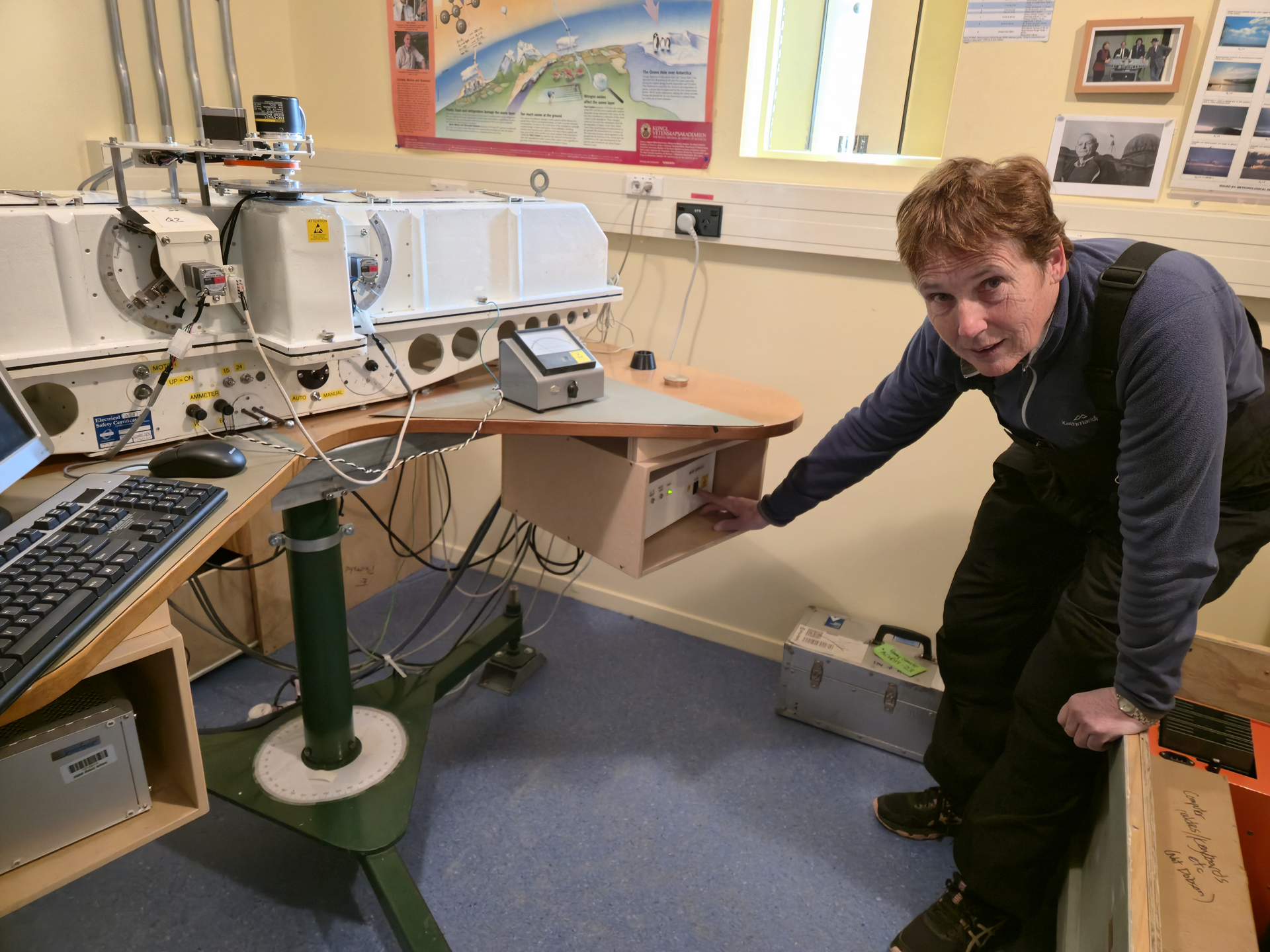
Sylvia Nichol turns off Dobson #17 for the last time. [📷 Penny Smale, ESNZ]
Early in October 2026, Earth Sciences New Zealand’s Dobson #17 spectrophotometer was decommissioned, marking the end of an era for both the instrument, and the scientist who has been part of its history in Antarctica. Sylvia Nichol, Earth Sciences New Zealand atmospheric scientist who was there for its final measurements and pack down, had last seen the Dobson in 2015.
“To be able to be there again to do the last measurement, that was a real privilege and very special. It was like getting reacquainted with an old friend. It’s a beautiful instrument,” says Nichol.
Dobson #17 began measuring total column ozone from Antarctica New Zealand’s Arrival Heights laboratory near Scott Base in 1988. Standard operation requires sunlight, but its ability to use moonlight as an alternative was a valuable feature in Antarctica, allowing measurements around the time of the full moon during the 24-hour darkness of winter. The result is a unique 38-year time series with around 100–120 measurements taken across each year, showing seasonal variation in ozone levels. During its long service the Dobson played an important part in tracking the recovery of the ozone hole, following international efforts to prevent ozone depletion from the late 1980s.
Nichol was only a few years into her career when she had the opportunity to accompany the Dobson to Arrival Heights in 1988 for its installation. On that trip she made the first measurements and continued to work with the instrument throughout the rest of its time in Antarctica, with 14 trips under her belt. Nichol says that over that time she’s developed a fondness for the Dobson.
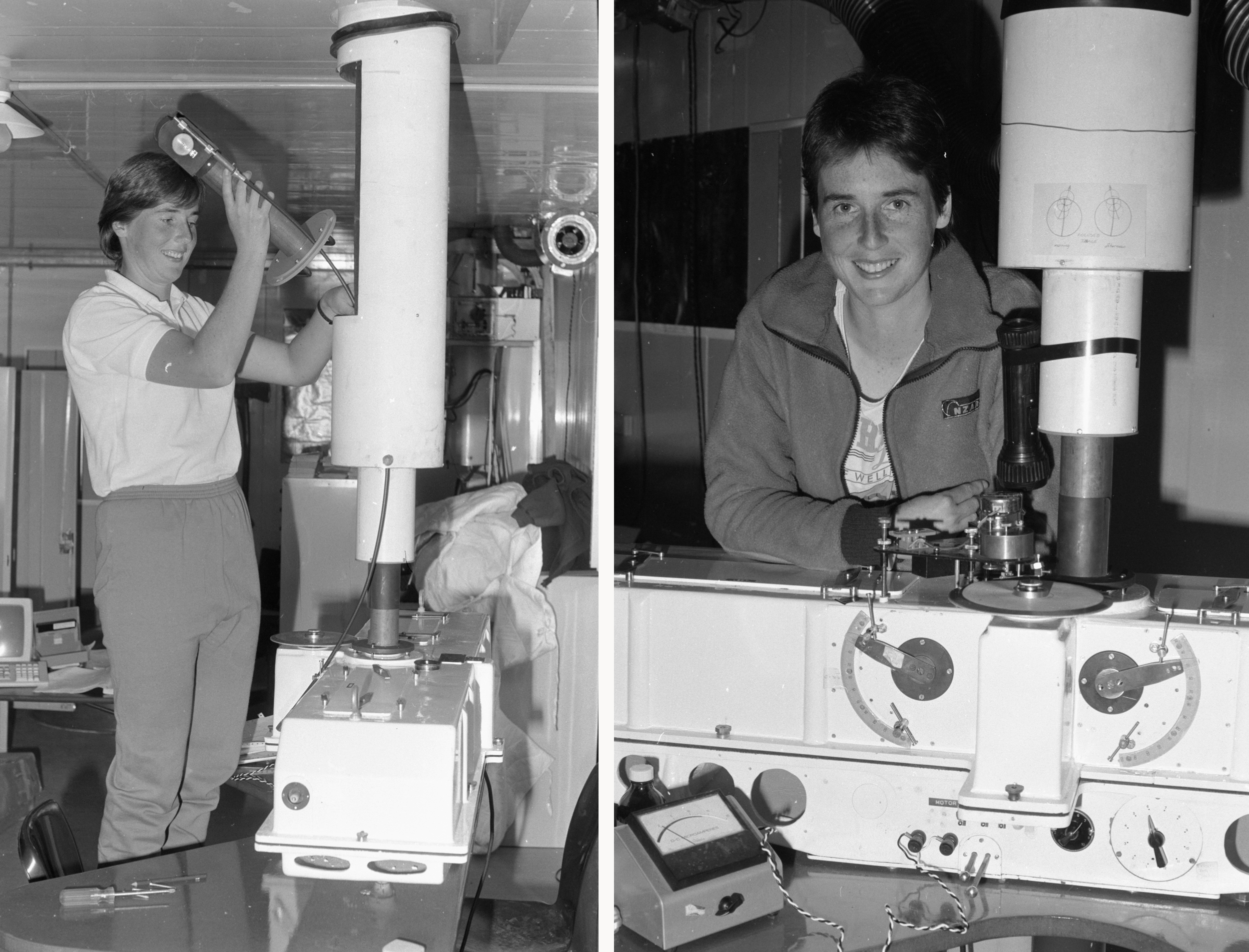
Setting up the Dobson #17 in Arrival Heights laboratory 1988 (left), and Sylvia Nichol with the Dobson in 1990 (right). [📷 Cath Gilmour / Antarctica New Zealand ]
“It’s got a bit of character to it. With a lot of instruments, you just push a button. But with the Dobson, you’re physically making the measurement and you can get a feel for how it’s operating or how well you’ve got things set up. So, you kind of have a personal relationship with the instrument. that might sound a bit odd, but it's been part of my life for so long.”
Getting the Dobson up-and-running down south required a special modification for the tough Antarctic conditions so that it could remain in the warmth of a building – a unique periscope running from the Dobson up through the roof providing access to sunlight and avoiding the shock of being wheeled outside into the cold. A sun director prism at the top of the periscope was adjusted throughout the measurements to direct the sunlight down to the instrument waiting below.
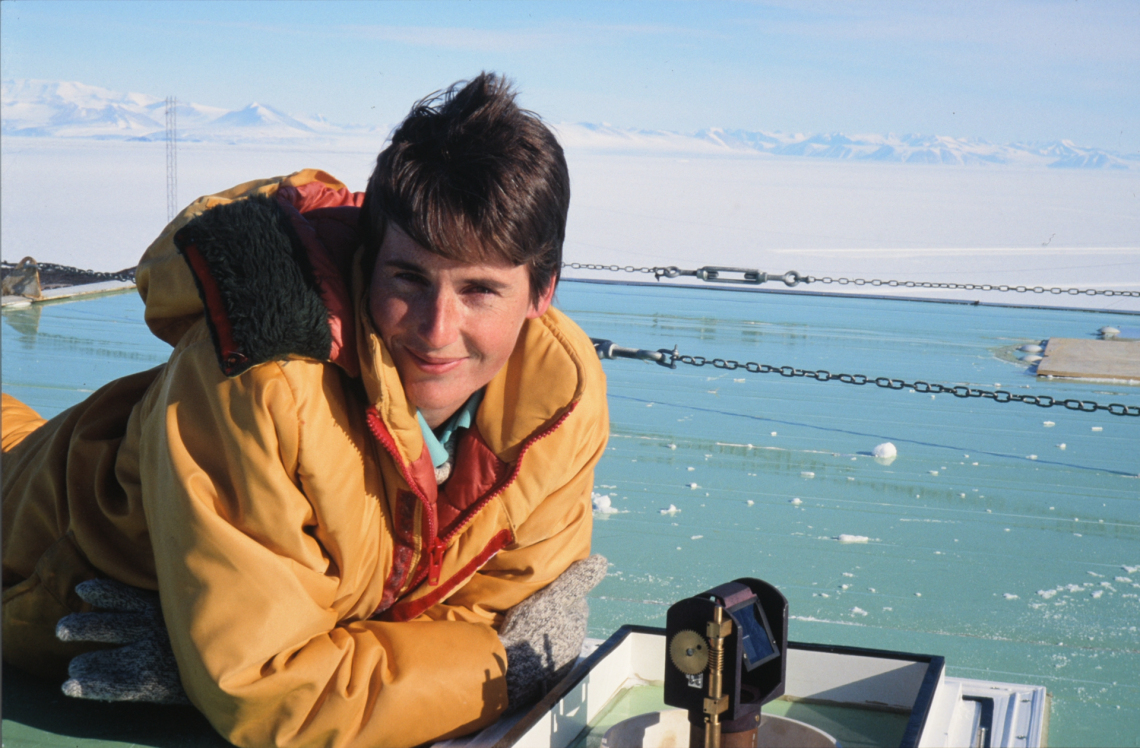
Sylvia Nichol with the Dobson’s sun director in 1990. [📷 Antarctica New Zealand]
Nichol returned for a trip during the Dobson’s first winter at Arrival Heights, making her first moonlight measurements with the instrument, and training the Antarctica New Zealand science technicians who were braving the long cold winter. Her subsequent visits were to provide training for the technicians, and to oversee two significant automations in 2006 and 2015.
Nichol says that when she flicked the switch to power down the Dobson, she felt a twinge of sadness, but that soon shifted to admiration.
“I reflected on what an amazing service we’ve had from the instrument over the years. There were only two or three breakdowns over its whole time at Arrival Heights. It’s been a wonderful instrument.”
Dobson #17’s fate is still to be determined. It will return to NZ and may be used for spare parts for the other Earth Sciences New Zealand operated Dobson at Lauder atmospheric research station, become part of an Antarctic and atmospheric science museum exhibit, or be donated to the World Meteorological Organization for deployment elsewhere.
Ozone measurement continues from Arrival Heights with new instruments
Dobson #17 is more than 90 years old, and technology has moved on, with newer instruments now available.
Dr Richard Querel, project manager for Earth Sciences New Zealand’s ozone measurement research, says that the number of Dobsons in operation globally is in decline, with the atmospheric research community moving towards replacements for Dobsons for some time.
“Dobson spectrophotometers remain the gold-standard for total column ozone measurements. The international scientific community is working through how to best maintain continuity across the transition to newer, more sophisticated instruments that are much more capable, and how to best integrate this range of newer instruments.”
Earth Sciences New Zealand has other instruments at Arrival Heights that measure ozone and other trace gases, and have been running alongside the Dobson for several years.
“Continuing to observe and understand changes in the atmosphere is a high priority for our research programme. These other instruments will provide continuity for the unique and important ozone time series that the Dobson leaves as its legacy,” says Dr Querel.
Monitoring changes in ozone hole still important despite early signs of recovery
Ozone plays a vital role in protecting life on Earth from harmful UV radiation.
While the Montreal Protocol of 1987 successfully galvanized an international response to phase out ozone-depleting substances, an ozone hole remains and is expected to occur every spring for another 50 years. The largest ozone hole for September in 20 years was recently observed, driven by a very strong polar vortex and cold temperatures over the south pole.
The ozone hole impacts weather and climate across the Southern Hemisphere, so improving our understanding and ability to predict the changing ozone hole is important for New Zealand.
“The ozone hole can be impacted by climate-change related events such as bushfires, volcanic eruptions, rogue emissions, etc., so as our climate changes it is important we continue to track its recovery,” says Dr Querel.
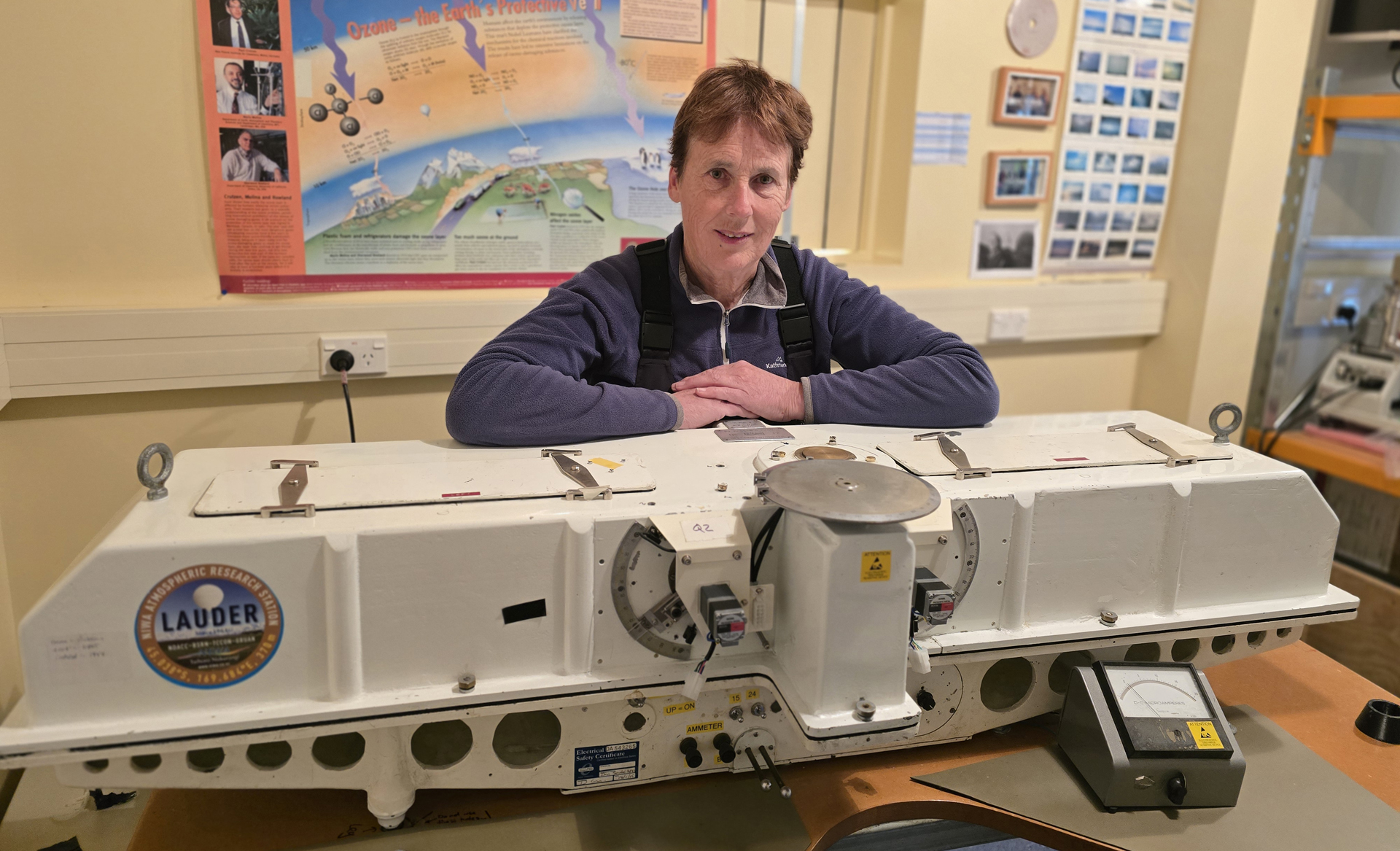
Sylvia Nichol takes old friend Dobson #17 on its final journey. [📷 Penny Smale, ESNZ]