
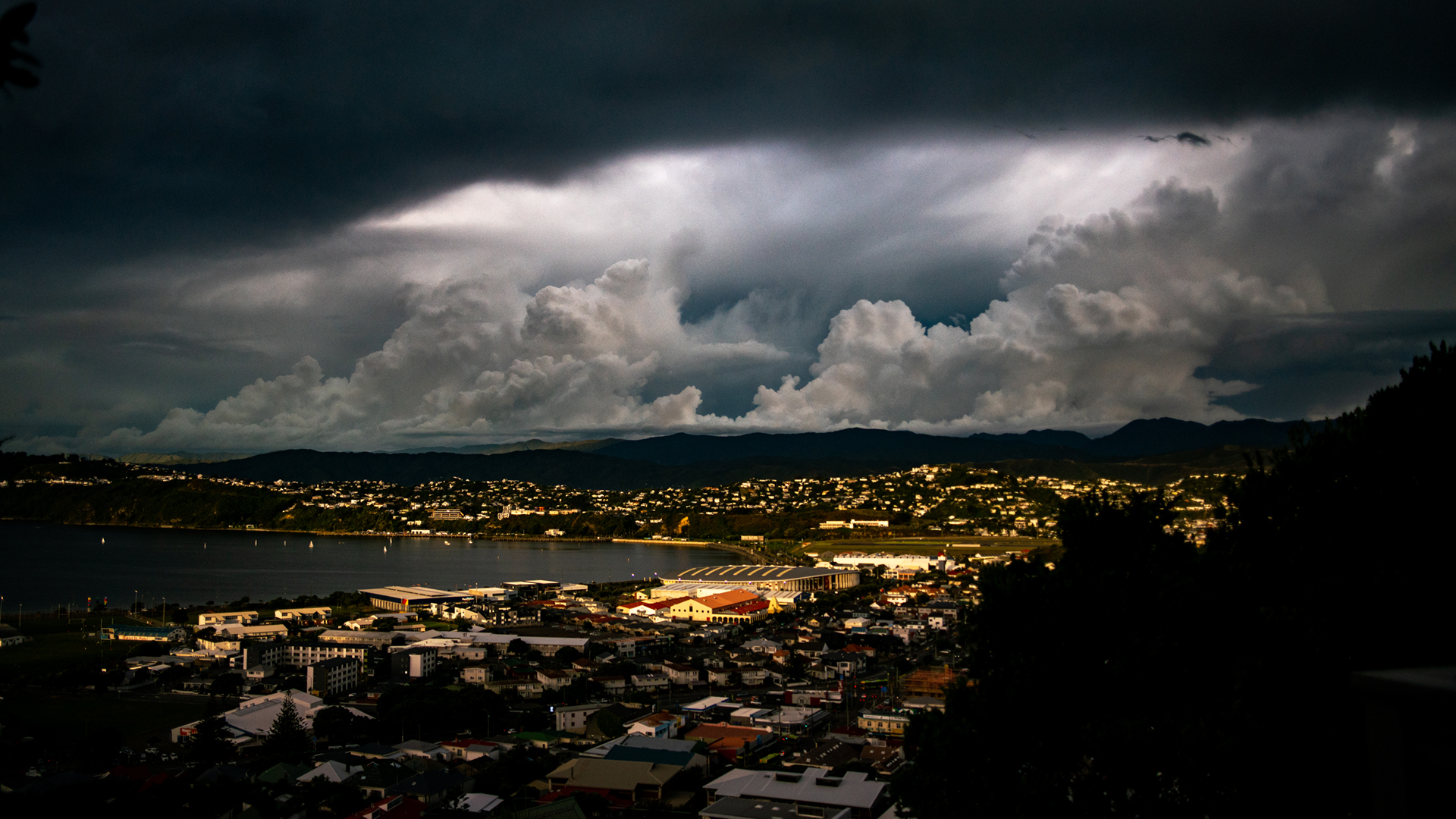
Storm clouds over Wellington [📷 Hannah Creary]
Climate projections are a vital tool for understanding the future impacts of climate change and supporting robust climate-risk decisions. A ‘physics-based’ approach is traditionally used to produce them, through computer models that simulate the Earth's climate system using the fundamental laws of physics governing the atmosphere, oceans, land, and ice. Scientists run these models many times, making small changes to the starting conditions to explore how the climate could vary naturally, and testing different levels of future greenhouse gas emissions. However, producing detailed projections at a regional level is computationally expensive.
The new approach pioneered by the Earth Sciences New Zealand-led team, and published in Climate Dynamics, trained generative AI on high-resolution climate simulations from a physics-based regional climate model. The AI was then used to produce a large volume of high-resolution climate projections for New Zealand within six hours, something that would have taken years with the conventional approach.
“The computational cost of regional climate models has previously limited how many possible futures we can simulate, particularly at the fine spatial scales needed to understand climate risks to communities and New Zealand’s critical infrastructure.”
Dr Neelesh Rampal, Earth Sciences New Zealand Data Scientist, and study lead author.
“Using generative AI, we were able to simulate hundreds of possible futures through to 2100. Analysing many simulations together allows us to better predict changes and trends in the rare events that can cause massive impacts, such as 1-in-100-year rainfall events.”
Harnessing the efficiency of AI and equipping it with physics-based knowledge
As the planet warms, future climate conditions will increasingly differ from those of the past and present. This creates a challenge for AI models trained on historical data: when applied to much warmer or otherwise unfamiliar climate conditions, they can produce unrealistic predictions or ‘hallucinations’.
“High-impact weather events such as tropical cyclones and extreme rainfall are inherently rare, so there are relatively few historical examples that the AI can learn from,” says Dr Rampal.
The team tackled this hurdle by training the AI using a 140-year simulation from a physics-based regional climate model covering both a historical simulation, and a projected warmer future. Training the AI on the simulated future conditions gave it experience with the warmer temperatures and heavier rainfall not present in historical records.
Additional physics-informed constraints helped guide the AI towards producing realistic weather patterns and extremes.
“We didn’t just train the AI on the past and assume it would work in an unfamiliar future climate,” says Dr Peter Gibson, Earth Sciences New Zealand climate scientist, and co-author of the study.
“The physics-based simulation provided the scientific foundation, and, importantly, the training data. The AI then extended it across many more models, emissions pathways and plausible futures.”
The team also tested the AI model against a separate set of physics-based climate simulations that it had not been exposed to during training. It successfully reproduced the expected climate patterns and projected changes in rainfall and temperature, providing an independent check that it could perform reliably beyond the simulations it had learned from.
AI projections offer new insights into extreme rainfall
The study generated more than 15,000 simulated years of daily rainfall and maximum temperature at a 12 km resolution across New Zealand, providing projections through to 2100. This is not a projection of our climate 15,000 years into future – the AI simulated the rest of this century many times over, allowing the researchers to see how extreme events could play out across many different futures. Enabled by AI, this comprises the largest set of high-resolution simulations produced to date for New Zealand.
Averaged across New Zealand, annual maximum rainfall (the highest daily rainfall each year) increased by approximately 5.6% for each degree of warming, and the occurrence of 1-in-100-year rainfall events increased by approximately 9% per degree of warming. While these results are similar to those uncovered in previous studies, the new dataset captured these changes at a much finer spatial resolution than previously possible, revealing more local detail.
The rich dataset has revealed something not previously identified for New Zealand: that increased warming also leads to an increase in the natural volatility of atmospheric moisture – reflected in an increase in the year-to-year extreme rainfall. The study found that the range of plausible rainfall extremes widened considerably as the climate warmed, and additional work is underway to further understand this.
Supporting more robust adaptation decisions
By simulating hundreds of possible futures, the team could access better estimates of both the expected change and the likelihood of high-impact rare events that may place the greatest pressure on infrastructure, emergency management, water resources and communities.
“With carefully designed and rigorously tested AI climate emulators, it is now practical to produce large collections of projections, improve our estimates of the likelihood of extreme weather events, and ultimately help support climate resilience,” says Dr Rampal.