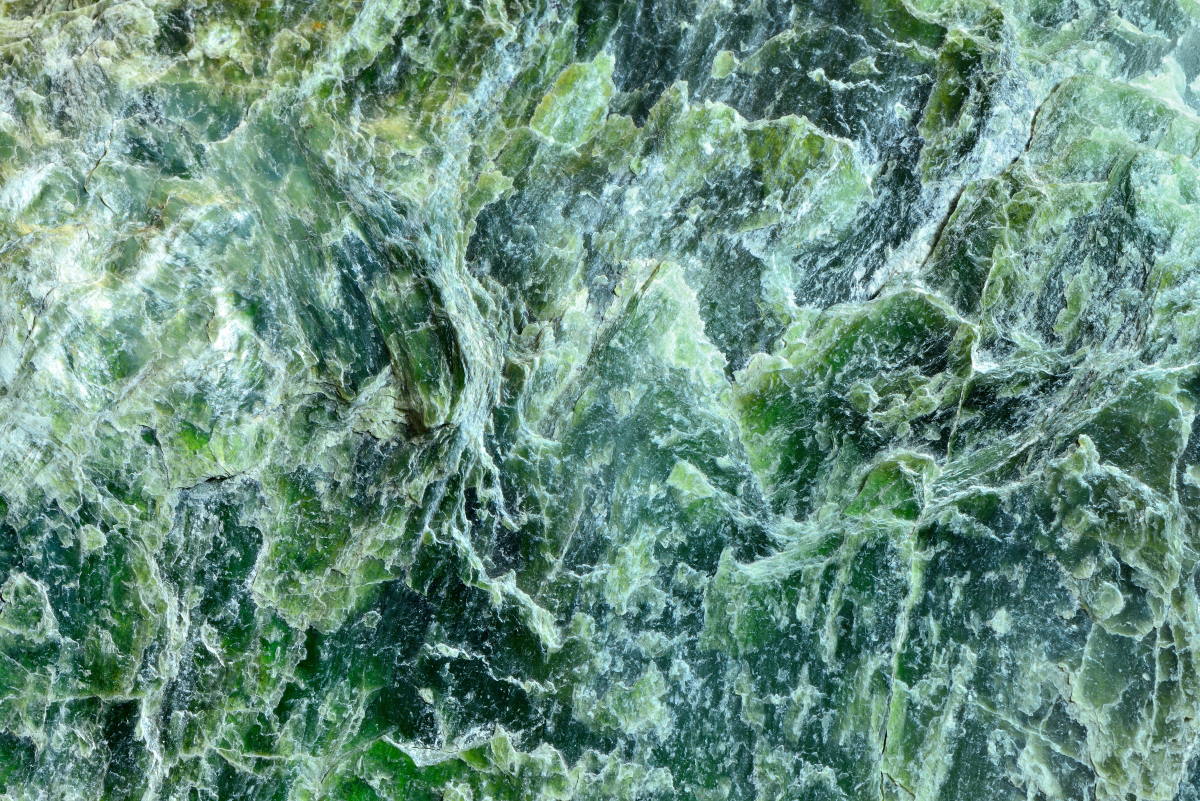
The research is part of University of Otago PhD student Natalia Seliutina’s investigation into the microscopic structures that give pounamu its unusual physical properties.
Because the samples are much smaller than those normally used in rock-mechanics laboratories, the team drew on techniques and facilities across several disciplines at Otago. Nanoindentation (microscopic pressure points) and four-point bending tests were used to measure properties including hardness, strength and resistance to fracture, while electron microscopic examination revealed how cracks interact with densely interwoven mineral fibres in pounamu.
Unlike many engineered fibrous materials, high-quality pounamu can withstand very high loads but then breaks suddenly once its critical strength is exceeded. The results point to reasons for the toughness of pounamu, but they do not yet provide the whole explanation.
One of the most intriguing results came not from a machine, but from experienced pounamu carvers.
Samples independently ranked by Māori carvers as being the best quality for carving also recorded the greatest fracture toughness.
“That is a really important result,” Ms Seliutina says. “The people who work with pounamu every day can feel and recognise properties of the stone that we are now able to detect and quantify in the lab. Bringing those different forms of knowledge together gives us insight that neither approach could provide on its own.”
The research draws on the Beck International Jade Research Collection, gifted by the late Russell Beck for pounamu and jade research and now curated within Earth Sciences New Zealand’s National Petrology Reference Collection.
The wider Marsden project puts geology, materials science and archaeology alongside the knowledge and experience of pounamu carvers and Ngāi Tahu. In October 2025, 22 carvers and others with deep knowledge of pounamu joined scientists for an “Inside Pounamu” laboratory hui at the University of Otago to examine the stone, undertake experiments and share knowledge.
Paul Madgwick, Chair of Te Rūnanga o Makaawhio, says combining new scientific understanding of pounamu with longheld mātauranga is vital.
“Learning everything we can about pounamu supports our kaitiakitanga of this precious material and helps protect it as an enduring taonga.
“This new science supports other work to trace pounamu samples to their original locations, which helps reaffirm Ngāi Tahu ownership and protection.”
Dr Cox says the work is revealing that there is still much to learn about a material that is both scientifically remarkable and culturally unique to Aotearoa.
“Pounamu is much more than an interesting geological material. It is a taonga with whakapapa, history and living cultural significance. The privilege for us as scientists is being able to use modern analytical tools alongside generations of knowledge to understand it better. We are hopeful that understanding its structure will lead to development of equally tough materials”