
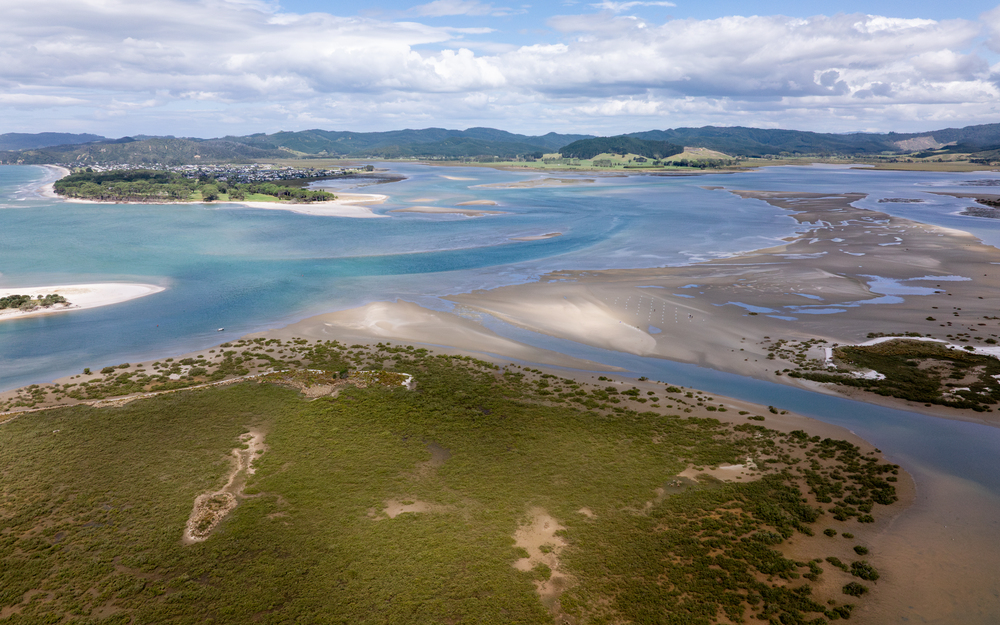
For nearly four decades, Auckland Council has been counting invisible creatures on estuary seabeds: tiny invertebrates that most people never see but that the ecosystem depends on. That commitment to long-term monitoring has just yielded a discovery that changes how scientists think about estuary health and resilience.
The project team included researchers from Earth Sciences New Zealand and Yokohama National University in Japan. Working together, they analysed a subset of Auckland Council’s monitoring data, applying innovative analytical frameworks developed for grassland ecosystems to our coastal waters in Aotearoa New Zealand.
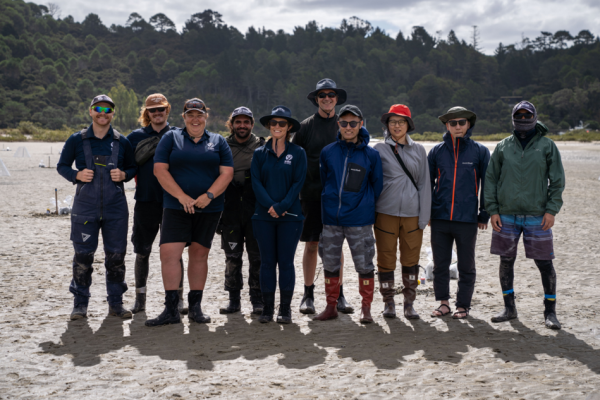
Scientists from New Zealand and Japan on an intertidal sandflat.
The macrobenthic invertebrates - the worms, small crustaceans, and other seabed animals collected from sediment cores - turned out to be key storytellers about ecosystem stability.
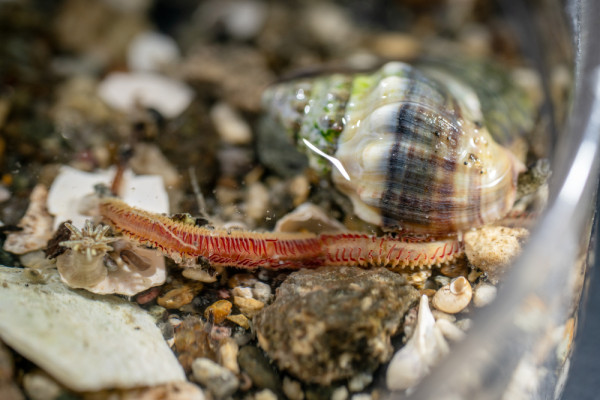
A polychaete worm (foreground) and gastropod (snail, background), are among the many macrobenthic animals found in estuarine sediments [Stuart Mackay]
The surprise wasn't what you'd expect. Community stability wasn't about having the most species. Instead, it depended on something called asynchrony - the ability of different species to rise and fall at different times, like instruments in an orchestra playing their own rhythms. When one species declines, another steps in to keep ecosystem functions going.
"Stressors affect different species differently," explains Orlando Lam-Gordillo, one of the lead researchers.
"In some estuaries, the same environmental change might wipe out one community but barely touch another. That variation is actually what keeps estuaries resilient."
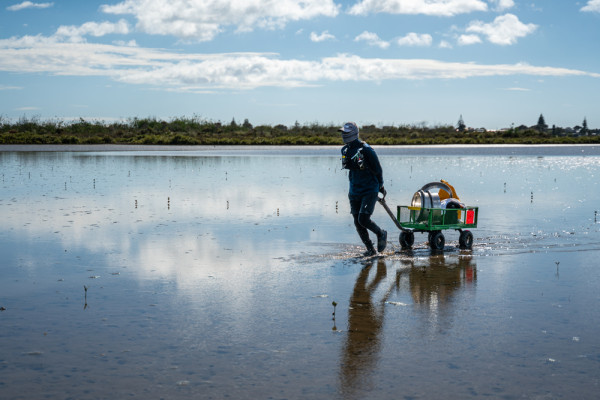
Orlando Lam-Gordillo, one of the lead researchers out in the field
This is why Auckland Council’s decision to initiate and persist with monitoring is so important. Hypothesis-driven research answers specific questions. But long-term monitoring reveals patterns that take decades to emerge - the kind of patterns that guide real decisions about restoration, management, and the resources needed to protect our estuaries.
The team also found that species' biological traits - how they feed, how they reproduce, how they tolerate stress - can help predict how communities will respond to multiple environmental pressures at once. That insight opens the door to smarter management strategies that work with ecosystem dynamics rather than against them.
"You can't see these animals without a microscope, and you can't understand them without decades of data," says Drew Lohrer, Strategy Manager Coasts and Estuaries at Earth Sciences New Zealand.
"But they're doing the work of keeping our estuaries alive. The research shows why monitoring - even when it's unglamorous - is the foundation of our understanding."
The findings have implications far beyond Auckland. A companion study showed that understanding species' biological traits helps predict responses to multiple global change drivers simultaneously. As climate change, coastal development, and sediment stress pile on, the ability to predict how communities will adapt becomes increasingly critical.
The research has been published as "Macrobenthic metacommunity stability increases with species asynchrony not species richness” in the international peer-reviewed journal Communications Biology, with the study’s backstory explained in “The value of the unseen: how tiny animals stabilise estuarine ecosystems".